Picture this:
It’s a regular Tuesday.
A produce truck pulls up to the back door 45 minutes before the lunch rush. A busy crew member signs for a few cases of romaine, some tomatoes and a box of peppers. The invoice goes into a folder somewhere. The cases go into the walk-in with everything else.
Three weeks later, an outbreak tied to leafy greens hits the news. The FDA wants to know exactly which lots of lettuce went to which of your locations.
They’ve asked for information within 24 hours.
But they aren’t actually ASKING.
So … how long would that take your team?
Starting July 20, 2028, this question isn’t hypothetical anymore.
What FSMA 204 Asks of Restaurants
The Food Safety Modernization Act became law in 2011. Section 204, better known as the FDA’s Food Traceability Rule, is the piece that reaches all the way to the restaurant back door.
The rule covers foods on the FDA’s Food Traceability List. Check that list and it reads like a QSR prep line: fresh leafy greens, tomatoes, peppers, cucumbers, fresh herbs, shell eggs, soft cheeses and fresh-cut fruits and vegetables.
For restaurants that receive covered foods, the requirements come down to four things:
- Receiving records. Every delivery of a covered food needs key data elements tied to its traceability lot code, including the lot code itself, product description, quantity, date received and where it came from.
- A traceability plan. A written plan that explains how your organization keeps those records and who the FDA should contact.
- Two years of history. Records stay on file for two years.
- A 24-hour turnaround. When the FDA asks for records, you have 24 hours to produce them. During an outbreak or recall, that often means an electronic sortable spreadsheet.
Brands that run commissaries or central kitchens may have additional records to keep for food they prepare and ship to their own locations.
2028 Is Closer Than It Looks
The original compliance date was January 2026. The FDA moved it to July 20, 2028, and Congress directed the agency not to enforce the rule before then.
Sounds like you’ve got plenty of time. You don’t. Not really.
Think about what it actually takes to change the receiving process at a single restaurant, not just for you but also for your suppliers.
Now multiply that by 500 locations. Or 5,000.
Traceability Runs on Tech
The rules are totally technology neutral. If you want to use pen and paper, it’s not illegal or anything.
But a stack of old invoices in a beige filing cabinet are going to make for a very long day when the FDA calls and the clock starts.
The faster path runs through the devices your crews already touch every shift. GS1 US guidance for FSMA 204 calls for suppliers to encode lot numbers and other data in GS1-128 case barcodes. That’s a fancy way to say a lot code is just one scan away for a receiving crew who already has a working handheld.
The key word there is “working.”
A busted handheld at receiving means missed records. A dead label printer at prep means guesswork on the line. Your traceability program is only as strong as your endpoints.
And your endpoints are only as strong as your MSP.
Comment TRG peut aider
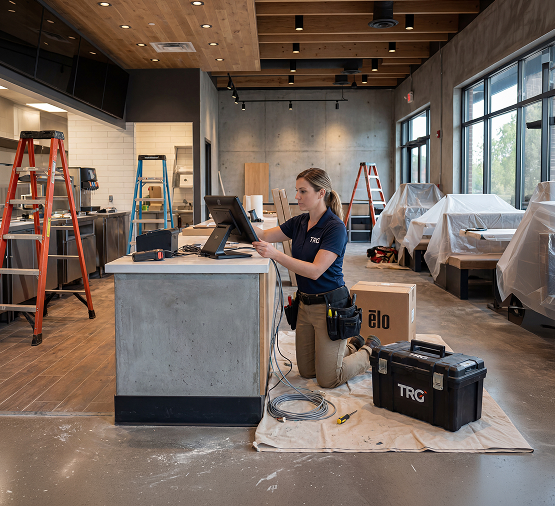
Not only can TRG help you pick the right hardware and software solutions, we can manage the full lifecycle of the back-of-house tech that feeds your traceability program, at every location, from rollout to retirement:
- Forward Logistics: Scanners, mobile computers and label printers sourced, staged and configured before they ship, then installed onsite by our technicians.
- Media & Consumables: Kitchen printer labels, ribbons, RFID labels and more for receiving, prep and food safety labeling.
- Automation: RFID & 2D Barcode inventory systems that track ingredients in real time.
- Unified Endpoint Management: Scanners, printers and tablets kept updated, configured and secured across every location.
- Maintenance & Support and Reverse Logistics: 24/7/365 help desk support, onsite repair and configured spares that ship the moment a device goes down, all tracked through ServiceHub®.
- OrderEase: A password-protected ordering portal where every franchise location reorders the same approved labels and hardware in a few clicks.
Already running a traceability platform? TRG keeps the hardware and software that feed it working. We’re device agnostic, so you choose the tech that fits your kitchen and we handle the rest.
/ T H E A R T I C L E I N N N E I N E I N E
Your traceability program is only as strong as your endpoints.
/ T H E D E A D L I N E
The FDA moved it to July 20, 2028, and Congress directed the agency not to enforce the rule before then.
/ T H E C H A L L E N G E E
When the FDA asks for records, you have 24 hours to produce them.
/ T H E N E X T S T E P
July 2028 will be here before you know it.